Part 20: Coliseum and Forum
Monday October 7:
If you have any interest in the archeology of Rome, the Basilica of San Clemente provides a comfortable lesson. Until the middle of the 19th century San Clemente was thought to have been built in the 11th century. But in 1857 a Dominican priest and Superior of the Dominican community there began excavations which showed over several years that San Clemente was built atop a 4th-century basilica that had once been the home of a Roman nobleman. In the first century it was the site of secret Christian services. Before that the basement of the building had been a temple for worshippers of Mithras a mystery religion existing in Rome from first to the fourth century. The home of the Roman nobleman had been built on the foundations of a building existing before the birth of Jesus. The excavations begun by Fr. Joseph Mullooly in 1857 would continue into the 21st century. Here are some pictures of the church. Photography in the excavated areas underneath is not permitted.


The
floor tiles were "re-cycled" from the 11th century
church..
The Coliseum
San
Clemente is about ¼ mile from the Coliseum.
And this is the glimpse you see as you
walk west on Via Labicana.

And
this is what you see when you get closer.

Elaria
was our guide for San Clemente and the Coliseum.
 |
| Picture by Gary Ong |
All around, you see work that will preserve what presently exists of the original Coliseum. And if you look closely in some places you can see how much that is needed.


The holes in the wall result from organized efforts in the Middle Ages to obtain material that could be used to construct other buildings.
So as you go through it, you have to imagine scenes like these artistic re-creations of a typical day in the life of a Coliseum.


The “games” at the Coliseum lasted all day (not 2-3 hours) and the tailgating took place inside, not in the parking lot. The attendees were mostly adult males. “Family entertainment” had not yet been invented. Capacity was about 60,00, and it was used for gladiatorial contests and public spectacles such as mock sea battles, animal hunts, executions, re-enactments of famous battles, and dramas based on Classical mythology.
All this stopped in the early Middle Ages when the Empire fell. Later it was used for housing, workshops, quarters for a religious order, a fortress, a quarry, and a Christian shrine. It was not until the 17th century when it once again began to gain respect, both for its original Roman uses but also as a sacred place in respect for the Christians who were martyred there.
Underneath the floor it was a complex of cages, passageways, stairs, tunnels and whatever else was needed to help stage the events.

The coliseum’s correct name is the Flavian Amphitheater, because it was built by the three emperors of the Flavian family (70 AD – 90 AD): Vespasian began construction in 70 AD, and it was continued, completed, and modified under Titus and Domitian. It is considered one of the greatest works of Roman architecture and engineering. It is built of concrete and stone, and is the world’s largest amphitheatre.
Here is something I learned in conjunction with this trip – the Romans invented concrete. They called it opus caementicium. With concrete they could build arches (which the Greeks could not), domes (the Pantheon) and permanent roads and aqueducts which carried supplies, armies, and water over long distances.


Looking from East end. Gladiators and other
performers entered through the Porta Triumphalis at the west end.

Seating was determined by status: the lower the tier the higher the status.
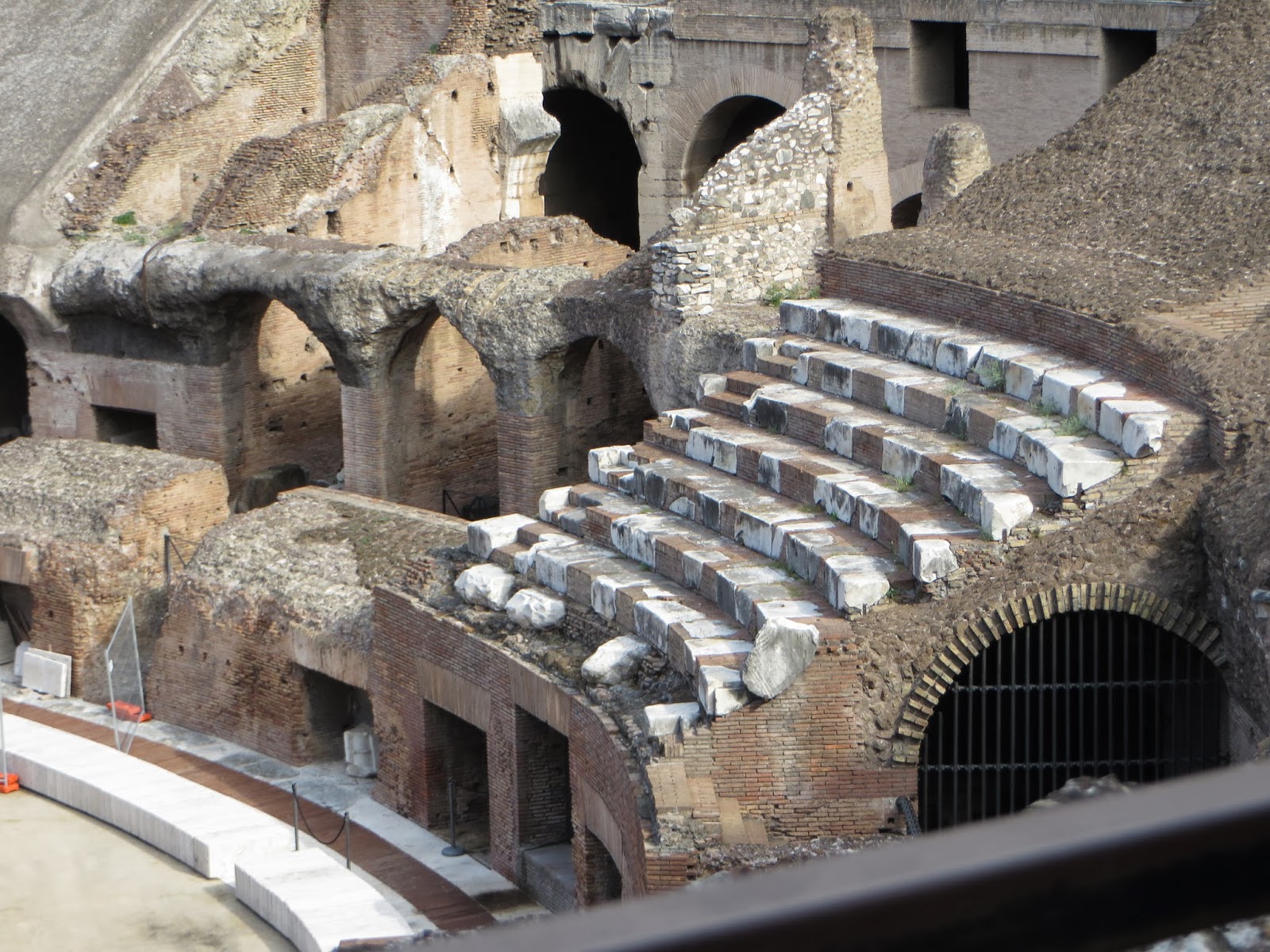
A fake “floor” has been constructed at the east end. The original floor was made of wood and covered with sand (The Latin word for sand is “arena.”). The tunnel at that end is the Porta Libitinaria. It was where the gladiators exited, alive or dead.

Today,
visitors exit through one portal at the south end.


The Romans exited through portals all around the building. They were called vomitoria, from the Latin “Vomitare,” meaning to spew forth.
The Forum
West of the Coliseum is The Forum, which today looks like a wrecking yard for domes, arches, and columns.Steves Guidebook is a bit more elegant:
The Forum is now rubble but imagine its prime: marble buildings with 40 foot columns;
processional chariots rolling down the Via Sacra. Imagine tribunes in togas instead of tourists
in T-shirts; an orator giving a rabble rousing speech. Imagine that Julius Caesar once leaned
against the rock you are sitting on.
The Forum was the political, religious and cultural center. It was the place for religious processions,
political demonstrations, elections and parades. For a while it was the center of the
civilized world.
I can imagine all that, but I also know that it has started
raining – not hard enough to call it quits, but hard enough to need an umbrella
and diminish your experience.

Arch of Constantine, actually outside the Forum area.

Here is what the arch looks like without scaffolding, thanks to Wikipedia

The arch was erected by the Roman Senate in 315 AD to commemorate Constantine's victory over Maxentius at the Battle of Milvian Bridge on October 28, 312. It is almost 70 feet high and 100 feet wide.
Arch of Titus, built about 70 AD to celebrate Rome’s conquering of
Judea, which brought 50,000 Jewish slaves to Rome who were forced to build this
arch and parts of the Coliseum.


The Basilica of Constantine.
These arches represent only about 1/3 of the original building, a huge hall of Justice (Early fourth century).
These arches represent only about 1/3 of the original building, a huge hall of Justice (Early fourth century).

Arch of Septimus Severus

Septimus and his two sons won important victories in Mesopotamia (Iraq today) in the last years of the 2nd
century. When Septimus died his sons became
co-emperors. This did not work out well.
One son (Caracalla) assassinated the other (Geta) and had his name and exploits
removed from the arch.
Beyond the arch is the Capitoline Hill.
Temple of Castor and Pollux

This is what is left of the Temple of Castor and Pollux,
twin gods who helped the Romans win a major battle in the 5th
century BC. A temple was built in their
honor. It became a meeting place for the
Senate, but was destroyed in a fire.
These columns are what is left of its successor built in 6 AD.
Temple of Antoninus Pius and Faustina

The Temple of Antoninus Pius and Faustina (about 150 AD).
The emperor A.P. built it as a temple for his wife Faustina. But after he died he was deified and a
succeeding emperor re-dedicated the Temple to Antonius Pius, as well as
Faustina.
At some time between the 7th and 11th
centuries it was converted to a Catholic Church, San Lorenzo in Miranda.
Temple of Vesta

This is what remains of the Temple of Vesta, the goddess of the
hearth. The Vestal Virgins tended a fire
that was never allowed to go out. As
long as this flame burned Rome would be safe.
The Vestal Virgins were chosen from noble families before they
were ten years old, and were supposed to serve a 30 year term. They took vows of chastity and if they served
their term successfully they received huge dowries and were allowed to
marry. If they failed they were publicly
shamed and buried alive.
The
Temple of Venus and Roma

The Temple of Venus and Roma is thought to have been the largest temple in Ancient Rome. It was dedicated to the goddesses Venus Felix ("Venus the Bringer of Good Fortune") and Roma Aeterna ("Eternal Rome"). The architect was the emperor Hadrian and construction began in 121 and finished in 135 AD.
There is a lot of this in the Forum - broken unidentified pieces that seemed scattered about.


Well, maybe it is time to call it quits. Some of our group stayed and even went to the
Palatine and Capitoline Hills adjacent to the Forum. We were there an hour – not enough time. We headed for the Metro station.
* * * * *
That evening we supped at Flann O’Brien’s Irish Pub where I had my
first beer since coming to Italy (I was building a liking for red wines), where
there were booths instead of tables and the walls were dark wood panelling (more
Italy firsts), and the hostess was a young Thai woman who spoke with a barely
intelligible Italian accent.