Tuesday, December 10, 2013

To Venice


Part 9:  To Venice

Sunday, October 29.  We have bus and train tickets, bags packed, and are up early and ready to catch the 10:10 “rapido” bus to Florence. It’s a 90 minute ride that will give us plenty of time to eat and catch the 2:30 train to Venice.  The weather report forecasts rain.  But we’re Portlanders, what’s a little rain.

How about a torrent, a deluge?  On the 10 minute walk to the bus station at Piazza Gramsci it came.  This was not Portland style rain.  The bus will be here in 30 minutes and we spend most of that in this little shelter with about 10 other people.


"I think this is our bus."

In 30 minutes “a” bus comes. Is it ours?  I am looking for “Tiemme,” the company that runs the bus we are supposed to catch.  This is not a “Tiemme” bus, and as it pulls into the station the driver changes the destination sign to “Siena.”  Nope, this isn’t our bus.  The driver opens the baggage doors and lets people climb on board.  Just to be sure I go to him and show him my ticket, just after he’s closed the baggage doors. He waves me away.  So I think this is not our bus.


I join Bonnie back under the shelter.  The bus pulls away.  We are the only ones left.  In a couple of minutes we both get bad vibes: “I think that was our bus.”  

I check the schedule board and the next “rapido” to Florence comes in 3 hours – just 15 minutes before our train (with reserved seats) leaves Florence.  That’s not going to work.  But there is an “ordinario” bus to Florence coming in 40 minutes.  We can catch that, but will it get us there on time?  The “ordinario” is a local.  The “rapido” is an express that travels the freeway.  Steves’ Guidebook says “avoid the 2-hour ordinario buses unless you have time to enjoy the beautiful scenery en route.”
 
So we wait for the "ordinario," which fortunately arrives on time.  We grab two of the few remaining seats. No baggage compartment, so we pretty much have to carry our bags on our laps.  This is no strato-highway cruiser.  It’s hardly more than a city bus with nicely padded seats.  And the windows are all fogged up because of the rain – so much for beautiful scenery.  Two hours and a couple of minutes later we get to the Florence bus station – ten minutes before the train is supposed to leave.  I think the train station is across a very busy street.  It is, and so we slosh across the street pulling carryons and dodging puddles and Italian drivers 

STOP!  Wouldn’t it be neat to have a camera crew following you and recording all this; just like The Amazing Race?   


The schedule board in the station says the train leaves from Track 9.  “Look, we’re right next to Track 9.”  In a minute a huge silver and red bullet-shaped rail monster glides in, and we board.  Venice, here we come. 


This is the “ferroargenta” (silver rail?).  In 2 hours and ten minutes (right on schedule) it takes us to Venice, with 3-minute stops at Bologna and Padua.  The view isn’t great (mostly tunnels as far as  Bologna, and industrial areas after that), but it’s smooth, speedy, very comfortable, serves snacks, and provides free Italian newspapers.   And restrooms that are twice the size of those on planes.

You come into Venice on a 3 mile causeway (Via Liberta) that carries across the Laguna Veneta trains, cars, buses and the thousands of people who work in Venice but live in Mestre on the mainland.  The island on the horizon is Burano, a separate island but part of the city of Venice.   The train ends at Santa Lucia station right on the Grand Canal


First task is to buy vaporetto tickets  (Venice’s water busses) that will  take us to our pensione.  When you step out of the train station you walk into the watery world of Venice.  Wow!


The church across the Canal is San Simeone Piccolo, built in the early years of the 18th century. It is one of the last churches built in Venice.  The yellow building to the right is the Ritz Carlton Hotel.

The Ritz Carlton has its own dock, as do many of the bigger hotels


Our vaporetto ride is short, just six stops until we disembark at Mercato Rialto, an outdoor produce and fish market that has operated continuously for 700 years.  Take that Portland!


Our B&B is a 2 or 3 minute walk from the vaporetto stop on a “street” (8 feet wide, at the most) called Calle Drio la Scimia.  This is where our Rick Steves tour group will stay. The tour starts at 4:00 tomorrow afternoon.
Our B&B is in a very old building.  But everything in Venice is in an old building.


Remember the rain in Siena?  Remember we waited for a bus for almost an hour?  This is the result.  All of Bonnie’s clothes are soaked.  Our room will look like this for 2 days.  My luggage gave a lot more protection; it was heavier and thicker, and only things on the bottom got wet, and none of them were clothes.


*     *     *     *     *
The rain was coming down hard and it was dark by the time we were ready to eat. Our Guidebook showed a restaurant close by.  But the rain was so bad and the temperature so low that we walked into the first lighted place we saw.  They sat us right away, in a seat by a floor-to-ceiling window.  We looked out the window and saw this.


We were practically under the Rialto Bridge.  How can the biggest oldest bridge in town sneak up on you?  

The Rialto Bridge was completed in 1591.  It replaced a high maintenance wooden draw bridge built in the 12th century.  It’s wide enough to support two lanes of kiosks/shops catering to tourists; so there are 3 lanes of foot traffic - one between the two lanes of shops, and two on the outer edges; and it’s covered.  It’s really a sight, and interesting to walk across.  After St Mark’s it’s probably the biggest tourist magnet in Venice.
The land on either side of it is also one of the lowest spots.  The other is Piazzo S. Marco   Both are the first places to flood after a big rain.  In fact “Rialto” is a contraction of “Rio” (river”) and “alto” (high), so it means “high water”. 

The bridge was great; the food wasn’t.  We spent 72 euros (about 97 bucks) for overcooked, previously frozen lasagna, spaghetti with a few mussels, a fish soup (that was OK) and house wine.  But it was “right on the canal” and the waiters wore white jackets.  I have forgotten the name of the place, but we were obviously paying for the view and location, and not the food.

A Re-Cycled Fort & Good Italian Food


PART 8:  Fortezza Medecea  & Good Italian Food  


 From the mid 13th to mid 14th century Siena was a major banking, trading, and military power.  Florence (50 miles up the road) was its chief rival, but both cities were of equal status.  In 1348 the Black Death struck Siena and a third of its population died. The city never recovered and Florence began to dominate the rivalry, finally conquering Siena in 1550.  Duke Cosimo Medici, a Florentine, who eventually became the first Grand Duke of Tuscany, ruled Siena.  So to protect Siena from rebellious Sienese troops trying to re-conquer the city, Cosimo commissioned a protective fortress.  It was completed in 1563 and remained a fort until the end of the 18th century. 


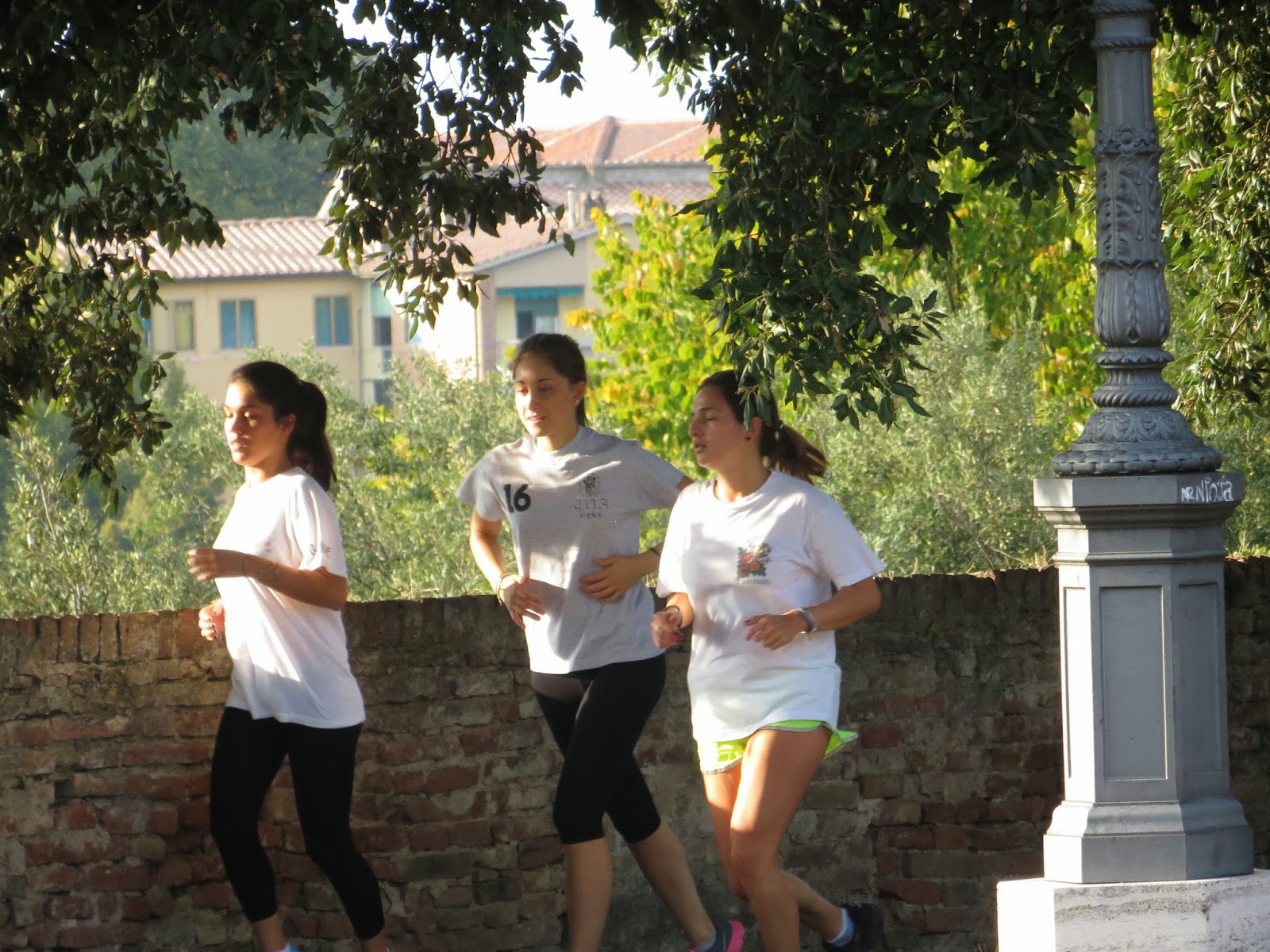
In 1937 after a major restoration, it was made into a public park.  Today it houses an Enoteca  promoting the local wine industry, is the home of the Siena Jazz Foundation, a jogging track, and a great place to stroll or sit and relax.  Outside the walls are parking lots that help keep the city a car-free zone.  The fortress built to repel invading rebels now repels the polluting, traffic-congesting auto.  Re-cycling at its best.


Eating in Siena

We stayed in Siena for three nights and had three fine evening meals.  Trattoria Tellini on Via dei Terme about 2 blocks from our B&B is a small family run 12 table place that opens every night at 7.  The food was very good - Pici with Cinghale for me, grilled polenta with basil, mushrooms and tomatoes for Bonnie, and a plate of very good grilled veggies that we split.  With house wine, and panforte for dessert we paid less than 40 euros.


Another night we ate at La Taverna di Cecco.  Rick Steves’ Guidebook describes this as a comfortable little eatery on an uncrowded back lane serving tasty salads and Sienese specialties made from fresh ingredients for a fair price.  That’s accurate; and I will add a really knowledgeable waiter.  It’s at Via Cecco Anggiolieri 19, a 5 -10 minute walk from Il Campo.


One night we had a do it yourself meal in our room.  We bought pizza, fresh fruit, salad and dessert at the Consorzio Agrario Siena, a small Whole Foods like grocery that sells all kinds of food products from Tuscany.  It’s an agricultural cooperative that has a wine bottling plant and agricultural supply stores in other Tuscan cities.  It was crowded and confusing but the pizza (even though only room temp when we got it back to the B&B) was very good.  See the comments on TripAdvisor for more descriptive information.


Tommorrow:  On to Venice

Monday, December 9, 2013

Siena's Duomo


PART 7:  Siena’s Duomo


This is the Duomo (Cathedral) di Siena.  In the notes I made while we were in Siena I said this is the most fantastic art building I had ever been in.  Every inch of the floor is carved pictorial marble.  The Picolomini  Library (in the north Transept) is fresco after fresco on wall and ceiling; old missals and graduals are lined along the walls and in the center of the room.   Even after seeing the Duomo in Florence and St Peter’s in Rome, the Siena Duomo remains my favorite.  The piazza in front of Florence’s Duomo is too small to allow you to see the whole of the building.  Getting into St Peter’s is a major wait. 

“The interior is a renaissance riot of striped columns, intricate marble inlays, Michaelangelo statues and Bernini sculptures.” (Rick Steves Guidebook).  We were there on a Saturday and the inside was crowded, but not enough to keep you from easily seeing what you wanted to see.  For 2 euros you can rent a tablet that is an excellent guide to the art in the Duomo and in the Baptistry which is a separate but attached building to the east of the Duomo.  And you can take pictures – but no flash.   


The pillars are made of black and white marble which are the colors on the emblem of Siena
.
The cathedral itself was designed and completed between 1215 and 1263 on the site of an earlier church built around 950.   

There are 56 marble panels on the floor, some as big as 20 feet across.  They were not completed until the 16th Century.


 Chapel of John the Baptist honors the relic of John the Baptist:  his arm.  Statue by Bernini.


.
.

Michelangelo sculptures of St Peter and Paul on either of the altar


The Piccolomini Library is a 20 x 60 ft (guesstimate) room off the left side of the Duomo.  The ten frescoes there depict 10 events in the life of Enea Silvio Piccolomini, a Sienese bishop who became Pope Pius II in 1458.  The works were commissioned by Francesco Todeschini  Piccolomini, then archbishop of Siena and the future pope (Pius III) and nephew of Enea.  Nepotism is not always a bad thing. But still you might want to read Pius III’s bio on Wikipedia.

              http://en.wikipedia.org/wiki/Pope_Pius_III

Pinturicchio painted the frescos in the early years of the 16th century, but they may have been designed by Raphael. 
 

This is the canonization of St Catherine by Pius II, and a close-up showing Raphael


Marvelous ornate psalters line the walls underneath the frescos.


The entire Library has a floor with marble moons


 These are the stairs leading out of the Library back into the Duomo.


The Altar


This altar was built in 1532 and designed by Baldassare Peruzzi. The enormous bronze ciborium was done about 1470.  It was intended for the Hospital of Sts Maria della Scala across the plaza from the duomo.  How do you access this monster?

The Pulpit


The pulpit was carved from Carrera marble by Nicola Pisano, considered the father of modern sculpture.  It sits in front of and to the left of the Altar, actually blocking the sight line to the altar.


The Choir


Originally there were 90 stalls in two rows behind the altar.  Today there are 36.  Each stall is crowned with the bust of a saint.

The Organ


The Baptistery

The Baptistry is behind and underneath the main altar. It was completed in 1325. To enter  it you have go outside the Duomo and down a long steep set of stairs. 
 
The Baptistry was completed about 1325, about 100 years after the Duomo.


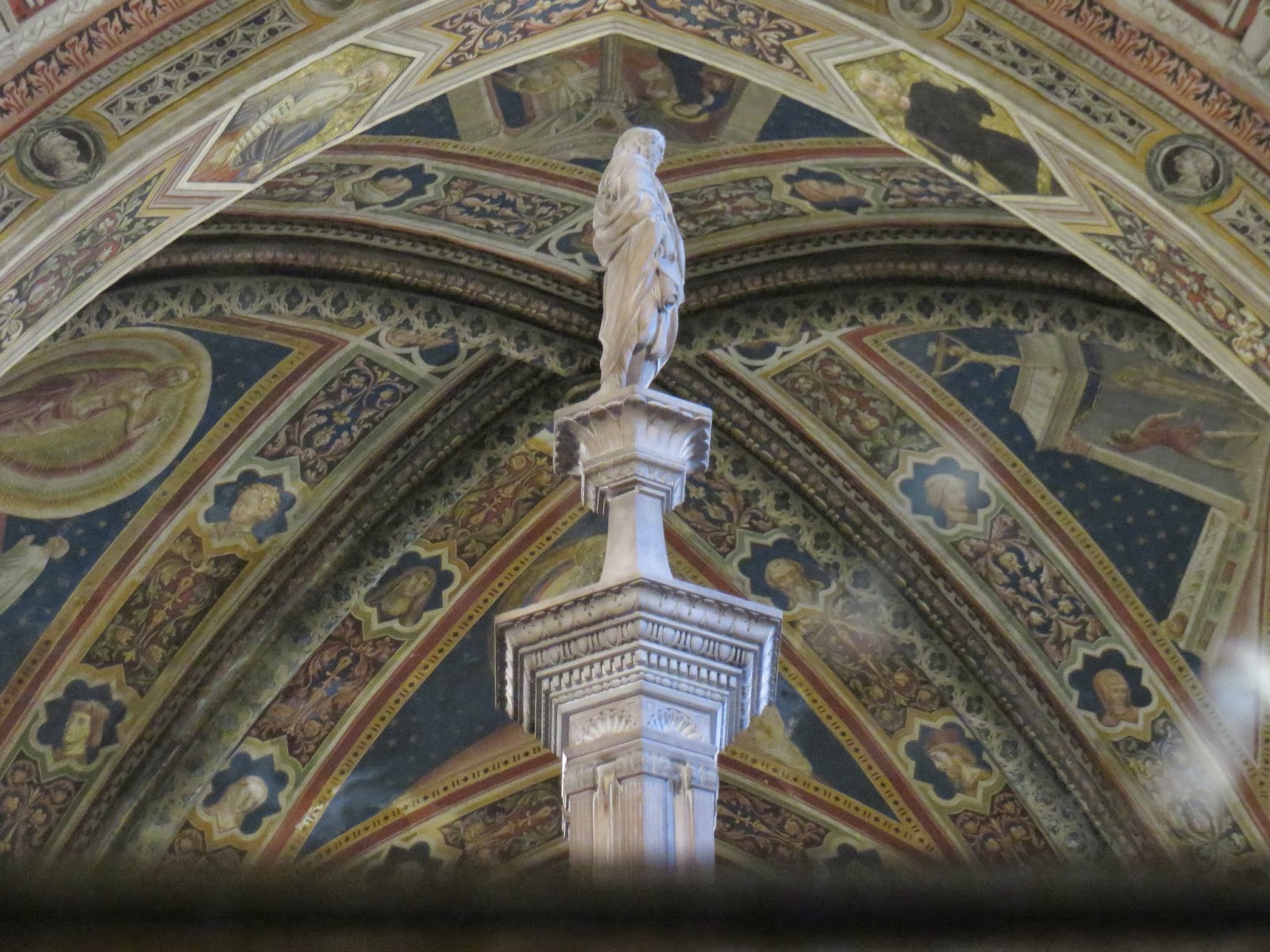
The six-sided baptismal font designed by Donatello dominates the interior.


Ceiling  of the Baptistery